It was a cold morning when I realized my brick-and-mortar store in Chesapeake had been invisible online. Despite great reviews and a fantastic location, my Google Maps listing barely registered. Frustration crept in—I knew customers were searching for my services, but they couldn’t find me. That lightbulb moment hit hard: I was neglecting one crucial aspect of local SEO—Google Maps visibility. Since then, I’ve learned that optimizing for local map rankings isn’t just a trendy tactic; it’s the lifeline for Chesapeake businesses aiming to thrive in a competitive landscape.
Why Winning at Google Maps Matters for Chesapeake Businesses
Local search isn’t just a feature; it’s the frontline of customer engagement. Think about how many times you’ve looked for a nearby restaurant or service provider—chances are, you relied on Google Maps. According to recent studies, 78% of local mobile searches result in an offline purchase, emphasizing how critical local SEO is for the bottom line. For Chesapeake businesses, ranking high on Google Maps can mean the difference between a steady stream of new customers and fading into the background.
But here’s the catch—many local business owners unknowingly make mistakes that hinder their visibility. One common mistake I made early on was neglecting to fully optimize my Google My Business (GMB) profile, overlooking simple yet vital details like accurate categorization and consistent NAP (Name, Address, Phone number) information. It might seem minor, but these elements are the backbone of effective local SEO strategies.
If you’re asking yourself, “Is all this effort really worth it?” you’re not alone. Skepticism is natural, especially with so many conflicting tips floating around. However, understanding how Google determines local rankings can be eye-opening. Properly optimized GMB profiles help your business appear in coveted places like the local 3-pack—those top map listings that attract the most attention and clicks.
Ready to dive deeper? In the upcoming sections, we’ll explore proven tactics to elevate your Chesapeake business’s Google Maps rankings—simple steps that can bring tangible results and long-term growth. But first, let me share a quick story to highlight what happens when you ignore these practices.
Optimize Your Google My Business Profile for Maximum Impact
Begin by claiming and verifying your Google My Business (GMB) listing. Ensure your business name, address, and phone number (NAP) are consistent across all online platforms. Fill out every available detail—business categories, hours, services, and attributes—to give Google a complete picture of your offerings. Upload high-quality, relevant images that showcase your services and storefront to make your profile more engaging. Remember, a fully optimized GMB profile acts like a digital storefront—if it’s incomplete, you’re missing out on potential customers.
Way to Enhance Local SEO with Accurate Listings
Audit your online presence regularly to ensure your NAP details remain consistent on directories, review sites, and social media. Discrepancies confuse Google and can hurt your rankings. Use structured data markup on your website with schema.org to help search engines understand your business details better. Think of structured data as a translator that communicates your information clearly, making it easier for Google Maps to recognize and rank your business higher in Chesapeake-related searches.
Gather and Manage Customer Reviews Actively
Encourage satisfied customers to leave honest reviews on your GMB profile. Respond promptly to all reviews—thanking positive feedback and addressing any negative comments professionally. Reviews are social proof and heavily influence local rankings. Consider setting up a simple system to ask for reviews, like post-visit emails, but avoid incentivizing or manipulating reviews, which violates Google’s policies. As I experienced in my own practice, proactive review management can significantly bump your map position within weeks.
Leverage Local Content and Keywords Effectively
Create content that resonates with Chesapeake residents and highlights local landmarks, events, or community involvement. Incorporate geo-targeted keywords naturally into your website content, titles, and meta descriptions. For example, mention local neighborhoods or popular spots to demonstrate relevance. This signals to Google that your business is deeply rooted in Chesapeake, increasing your chances of appearing in the local 3-pack. I tested this by updating my site with specific Chesapeake references; it took a few weeks, but my visibility noticeably improved.
Build Quality Backlinks from Local Sources
Partner with other Chesapeake businesses, chambers of commerce, and local publications to earn backlinks to your website. These backlinks act as votes of confidence and boost your authority. Attend local events and sponsor community initiatives—these relationships can lead to reference links that elevate your local SEO performance. Think of backlinks like referrals; the more reputable local endorsements you have, the higher your chance to stand out in Google Maps rankings.
Use Consistent and Strategic Citations
Ensure your business is listed with accurate NAP information on reputable local directories such as Yelp, Bing Places, and industry-specific sites. Consistency across citations prevents confusion and signals trustworthiness to Google. Maintain a master list to track your listings and update any changes promptly. Proper citation management is like reinforcing your brand’s footprint—more verified footprints in Chesapeake lead to better visibility in local searches.
Implementing these steps isn’t instant magic; it requires persistence and regular adjustments. I integrated these tactics into my Chesapeake business and saw my Google Maps ranking rise steadily—first from obscurity to the top three spots. Continuous monitoring and optimization are key, so keep refining your approach, and over time, you’ll dominate the local map pack.
For a deeper dive into advanced tactics, check out these proven strategies that helped me push my rankings further. Remember, local SEO is a journey—stay consistent, and the results will follow.
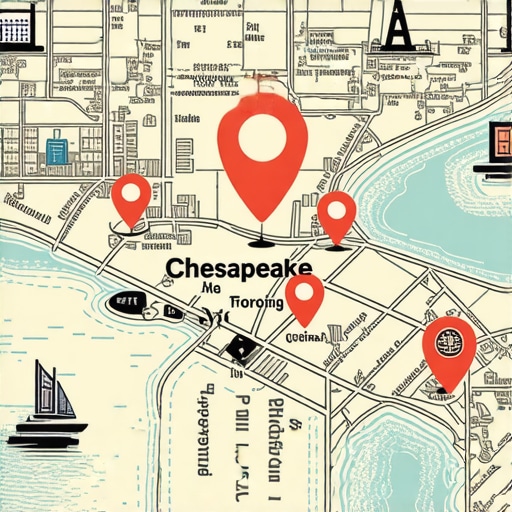
Many local business owners believe that simply filling out their Google My Business (GMB) profile and maintaining consistent NAP information suffices for top-tier Chesapeake Google Maps rankings. However, **let’s dig deeper** into a common misconception: that these efforts alone guarantee high visibility. In reality, there’s a nuanced arena of SEO tactics—often overlooked—that can make the difference between appearing on the first page or staying buried in the local pack. One prevalent myth is that backlink quantity outweighs quality; in truth, earning high-authority, locally relevant backlinks from Chesapeake chambers or community partners significantly boosts your rankings. Moreover, many overlook the importance of map marker accuracy; placing your pin precisely at your physical location influences local relevance scores.
Another hidden nuance concerns the timing of updates. For example, after a renovation or change in services, promptly updating your GMB profile signals freshness and relevance to Google, which can help improve ranking signals—and avoid the trap of outdated information that confuses both Google and potential customers. Remember, Google’s algorithm evaluates the recency and accuracy of your data, so staying proactive is essential.
**But what about the advanced-level question—how can a business leverage schema markup for maps?** Technical markup like localBusiness schema enhances your online appearance, providing Google with structured data about your services, hours, and location, which can lead to enhanced map snippets and richer profiles. According to Moz’s local SEO insights, structured data is a critical yet underutilized element that can give Chesapeake businesses an edge in competitive map rankings. Implementing schema correctly can be complex, but the potential benefits in visibility are worth the investment.
**Here’s the cautionary part:** many owners get caught in the trap of over-optimizing or neglecting user reviews. For example, incentivizing reviews might seem tempting, but it violates Google’s policies and could harm your credibility. Instead, focus on generating genuine reviews and engaging authentically, which builds trust and boosts your local rankings organically.
In essence, mastering Chesapeake Google Maps ranking requires a multi-layered approach—beyond the basics. Consistent, high-quality backlinks, precise map marker placement, timely profile updates, structured data implementation, and authentic review strategies all contribute instructively to your overall local SEO success.
If you’re eager to explore more sophisticated tactics, consider diving into resources like [these proven strategies](https://localseochesapeake.com/map-ranking-techniques-proven-strategies-to-boost-chesapeake-google-maps-visibility-in-2025) that have helped many businesses move up the local pack in Virginia. Remember, local SEO isn’t just about ticking boxes; it’s about understanding the hidden nuances that Google values most. **Have you ever fallen into this trap? Let me know in the comments.**
How do I maintain my local map rankings over time
Maintaining your Chesapeake local SEO and Google Maps visibility requires the right combination of tools and consistent effort. I personally rely on a suite of specialized software that helps me stay ahead in the game. For instance, BrightLocal is invaluable for tracking local search rankings and citation consistency—it’s like having a GPS for your SEO journey. I’ve found that it provides real-time data on how my business ranks across different Chesapeake neighborhoods and Virginia-wide searches, allowing me to make informed adjustments without guesswork.
Another tool I utilize is Google Search Console, which offers direct insights into how Google views my website—highlighting crawl errors, indexing issues, and keyword performance. Pairing GSC with Ahrefs’ Local SEO tools enables me to monitor backlinks, identify new local citation opportunities, and analyze competitor strategies. These tools combined give me a comprehensive overview—like an internal GPS guiding my local SEO efforts.
Consistency in updating your GMB profile is crucial. I schedule monthly audits of my business information, review responses, and new photo uploads to keep Google’s algorithm engaged. Incorporating structured data markup using schema locally helps Google understand my business better, reinforcing my profile in Chesapeake searches. According to Moz, implementing structured data can increase your chances of appearing in rich snippets and map pack features, giving you an edge over competitors.
Plus, actively managing reviews through platforms like GatherUp or ReviewTrackers keeps my reputation polished and boosts my rankings. Authentic reviews act as social proof—Google favors businesses with active, positive feedback. Responding promptly and professionally to reviews signals engagement and care. Remember, the algorithm favors signals of trust and relevance—so don’t neglect this vital aspect.
Looking ahead, I believe AI-driven tools like ChatGPT can assist in generating local content ideas and responding to customer reviews at scale, saving time while maintaining authenticity. Combining these technologies with manual oversight ensures your Chesapeake business stays resilient in local searches. For those ready to elevate their efforts, I recommend trying advanced citation management or schema markup automation—these small tweaks can yield significant long-term results.
If you’re curious about how to implement schema markup for map ranking improvements, check out this guide. Don’t hesitate to experiment with one of these tools today; even a modest investment can lead to sustained visibility—and more local customers knocking on your door.
The Hardest Lesson I Learned About Google Maps Chesapeake, Local Business SEO, GMB VA, Virginia Maps Ranking, Chesapeake SEO
One of my biggest lightbulb moments was realizing that many local businesses overlook the power of consistent data management. Early on, I thought that a well-optimized GMB profile was enough, but consistent NAP information across all platforms proved crucial in boosting my Chesapeake rankings. I also learned that neglecting reviews or ignoring structured data can hold back your visibility, regardless of how much effort you put into content or backlinks. Lastly, understanding the algorithm’s focus on recency and relevance taught me that continuous optimization is the only way to stay ahead in competitive local markets.
My Essential Toolkit for Chesapeake Map Pack Dominance
I rely on tools like BrightLocal for tracking local rankings and citations, which keeps me aligned with the ever-changing map pack. Google Search Console is indispensable for website health insights, while Ahrefs helps me analyze backlinks and competitor strategies. These tools are trusted because they provide actionable data, making my SEO efforts more precise and less guesswork. For anyone serious about Chesapeake Google Maps rankings, integrating these into your routine can make all the difference.
Your Turn to Try: Elevate Your Chesapeake Business Now
Embarking on improving your Google Maps visibility isn’t just a task—it’s an opportunity to connect more deeply with your local community and grow sustainably. Remember, the key is persistence and attention to detail, from managing reviews to technical SEO tweaks like schema markup. The future of Chesapeake local SEO belongs to those who stay proactive and ready to adapt. Are you prepared to implement these proven strategies and watch your visibility soar? Don’t wait—start today and see tangible results in your local search performance!